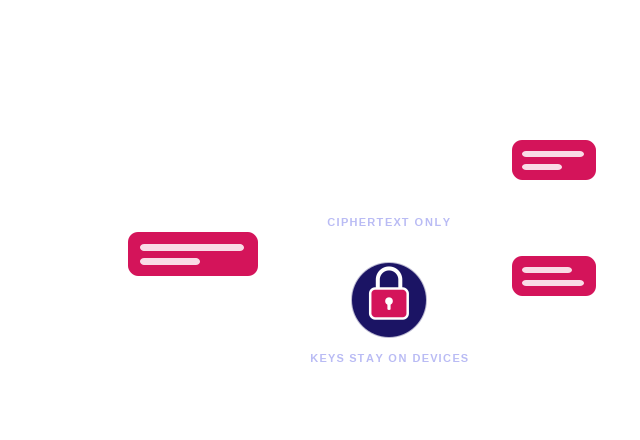
Cyfer is an end-to-end encrypted communication platform for chat, voice, video, and file sharing, within one organization and across several. Only the people in a conversation can read it. Cyfer’s servers store and forward ciphertext and never hold the keys that decrypt it.
The Cyfer product
End-to-end encrypted chat, voice, video, and file sharing. Only the people in a conversation can read it.
What Cyfer does
-
End-to-end encrypted messaging and files
Every room is one encrypted group under Messaging Layer Security (MLS, RFC 9420), the IETF standard for group messaging.
-
Post-quantum protection
Key establishment combines NIST’s ML-KEM with classical algorithms, so traffic recorded today stays unreadable when quantum computers arrive.
-
Encrypted voice and video
Real-time media is encrypted end to end with SFrame (RFC 9605), using keys derived from the room’s MLS group.
-
Conversations across organizations
Each organization joins from its own tenant, with its own keys and its own record. People without Cyfer join as guests by invitation.
-
Records capture inside the encryption
An organization installs its own capture as a visible member of each room. It records to an encrypted store on the organization’s own infrastructure, and Cyfer’s servers never see the content.
-
Security labels
Senders mark messages with CUI, TLP, legal, or financial markings, and rooms refuse content they are not accredited to carry. See Security Labeling.
-
Keys that stay on the device
Each device generates its own keys and seals them with the platform’s hardware-backed key store. Sign-in supports passkeys.
-
Tamper-evident evidence
Every admission to a controlled room, every refusal, and every removal is written to a hash-chained log that holds no message content.
-
Runs where you choose
Cyfer runs on Android, iOS, Windows, and the web. The services run in Cyfer’s cloud, in your private cloud, or in your own data center, as containers on Docker, Podman, and Kubernetes.
How it is built
Cyfer uses published standards and no proprietary cryptography. The full architecture and the cryptographic bill of materials are in the Cyfer Platform Technical White Paper.
Read the technical white paperFrequently asked questions
What is Cyfer?
Cyfer is an end-to-end encrypted communication platform for chat, voice, video, and file sharing, within one organization and across several. Only the people in a conversation can read it.
Is Cyfer end-to-end encrypted?
Yes. Every room is one encrypted group under Messaging Layer Security (MLS, RFC 9420). Cyfer’s servers store and forward ciphertext and never hold the keys that decrypt it.
Does Cyfer use post-quantum cryptography?
Yes. Key establishment combines NIST’s ML-KEM with classical algorithms, so traffic recorded today stays unreadable when quantum computers arrive.
What standards is Cyfer built on?
Cyfer uses published standards and no proprietary cryptography. Rooms are encrypted with Messaging Layer Security (MLS, RFC 9420), real-time media with SFrame (RFC 9605), and key establishment uses NIST’s ML-KEM.
Which platforms does Cyfer run on?
Cyfer runs on Android, iOS, Windows, and the web.
Can Cyfer be self-hosted?
Yes. The services run in Cyfer’s cloud, in your private cloud, or in your own data center, as containers on Docker, Podman, and Kubernetes.
What is Security Labeling?
Security Labeling lets a sender mark a message with a handling label, such as a CUI, TLP, legal, or financial marking, and lets a room refuse content it is not accredited to carry. The label is encrypted and signed with the message.
Talk to our team
Tell us what you need to protect, and we will show you how Cyfer handles it.