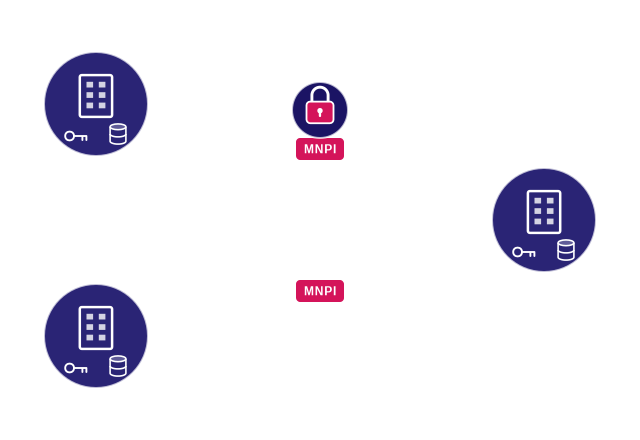
Cyfer gives deal teams one end-to-end encrypted conversation that crosses firm lines, in which each firm keeps its own keys and its own record. It is private across firms and complete on the record.
The problem: a firm has to choose between private and on the record
A sell-side mandate is live. The banker, the client’s CFO, outside counsel, and the buyer’s deal lead need answers in minutes, mostly from their phones. The firm’s approved tools stop at the firm’s edge, so the conversation moves to email, calls, and personal messaging apps.
That leaves two choices, and each one fails.
- Enterprise chat with an archiver keeps a record, but the messages are not end-to-end encrypted and the channel does not reach the client or the other side’s counsel.
- Consumer encrypted apps are private, but compliance cannot capture them, so every business message sent there is off the record.
The duties have not changed. Exchange Act Rule 17a-4, FINRA Rules 3110 and 4511, and Advisers Act Rule 204-2 require firms to keep and supervise business communications. Section 15(g) of the Exchange Act and Section 204A of the Advisers Act require policies that prevent the misuse of material nonpublic information.
A record the firm holds, captured inside the encryption
The firm installs its own records capture, which joins each room as a member. It receives every message the same way a person does and stores it in an encrypted store on the firm’s own infrastructure.
-
Nothing is decrypted in the middle
There is no gateway and no copy at the provider. Cyfer’s servers never see the content.
-
Nobody is recorded without knowing
The room shows a standing notice that it is monitored and lists the capture member by the firm’s name.
-
It cannot be quietly removed
A room under capture does not accept a change that removes it.
What Cyfer does for a financial firm
-
One conversation across every firm on the deal
Each firm runs its own Cyfer tenant and joins the conversation from it. A counterparty without Cyfer joins as a guest by invitation, so nobody has to buy anything to take part. The conversation is encrypted end to end across all of them under Messaging Layer Security (MLS, RFC 9420), for messages, calls, and files.
-
Inside information marked where everyone can see it
With Security Labeling, a sender marks a message MNPI. Every reader sees the marking as a banner above and below the message. The marking is encrypted and signed with the message.
A firm can show its own label names beside the standard Traffic Light Protocol level, for example “Internal · TLP:AMBER+STRICT”.
-
Deal rooms restricted to named people
A deal room can be bound to a dissemination list, so it admits only the people on that list. Someone added later sees nothing written before they joined. A room also refuses content it is not accredited to carry, which stops restricted material from landing in a general room by mistake.
-
A wall-crossing record the room writes itself
Each admission to a controlled room is recorded with who invited whom and the reason. The record is hash-chained, so any later change to it is detectable, and it holds no message content.
-
Protection for deal data that stays sensitive for years
Cyfer’s key establishment combines NIST’s post-quantum ML-KEM with classical algorithms. Traffic an attacker records today stays unreadable when quantum computers arrive.
-
Run it where you choose
Cyfer runs in Cyfer’s cloud, in your private cloud, or in your own data center. The services run as containers on Docker, Podman, and Kubernetes.
The same mandate, with Cyfer
- The control room creates a restricted room for the project and binds it to the dissemination list of wall-crossed people.
- The client, counsel, and the other side join from their own tenants or as guests.
- The firm’s records capture is in the room from the first message, visible to everyone.
- The deal team marks messages and files as they send them, and the room refuses content it is not accredited for.
- Each wall crossing is recorded with its reason as it happens.